

Solid State Technology
Semi-solid-state battery cells replace much of the flammable liquid electrolytes with highly stable solid state electrolytes
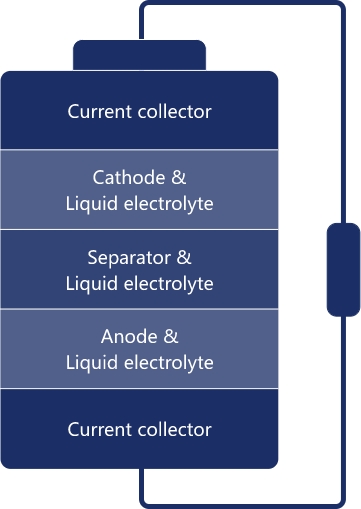
Conventional Li-Ion battery
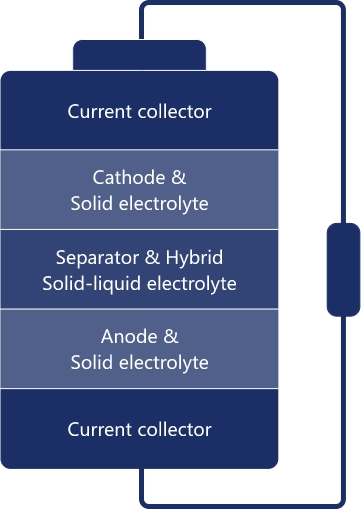
WELION
Semi solid state battery
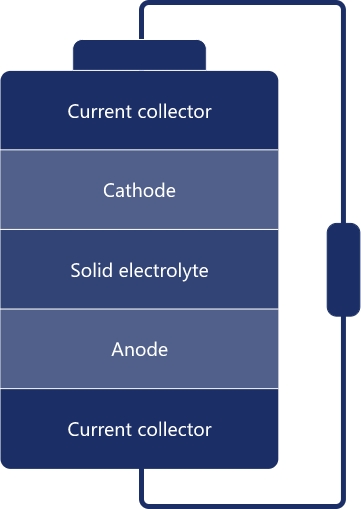
All solid state battery (ASSB)
The Semi-Solid State
Bridging the gap between
conventional liquid electrolyte cells and fully solid-state cells
WELION semi-solid-state battery
cells represent an intermediate state between conventional lithium-ion batteries with liquid electrolytes and
fully solid-state batteries. They take advantage of the properties of both technologies to increase safety and
energy density while controlling costs.
A safer hybrid electrolyte
A hybrid mixture of solids
and
liquid electrolyte is simply a safer chemistry
WELION semi-solid-state battery cells use a hybrid
electrolyte
which is comprised of solid matter surrounded by a liquid electrolyte. The resulting hybrid electrolyte results in
cells with a much lower risk of leakage, fire, and explosions that can occur in conventional lithium-ion batteries
with a fully liquid electrolyte as there is less flammable liquid in the cell. The unique chemistry also minimizes
the risk of „thermal runaway“, a problem that can occur with liquid lithium-ion batteries on the market today.
Energy density
Increasing energy density through innovative processes and materials
Batteries featuring WELION
semi-solid-state cells
offer higher energy density than conventional lithium-ion cells, thanks to our hybrid electrolyte chemistry,
innovative
cell structure, advanced materials, and cutting-edge manufacturing processes.
Processes:
- In-situ Solidified Electrolyte: Creates a stable and uniform electrolyte structure, improving battery safety
and longevity.
- Pre-lithiation of the Anode: Boosts the initial capacity and efficiency of the cells, ensuring superior
performance from the start.
- Special Mixing of the Solid Electrolyte: Optimizes ionic conductivity and mechanical strength, resulting in
higher energy density and better durability.
- Solid Electrolyte Coating of the Cathode: Protects the cathode material,
reducing degradation and extending the overall lifespan of the battery.
Materials:
- Ultra-thin Metallic Lithium Foil: Increases energy density, allowing for longer-lasting power in a compact
form.
- Ionic Conductive Separator: Improves ionic conductivity, enhancing the overall efficiency and safety of the
cell.
Despite these innovations, semi-solid-state cells have not yet matched the electrochemical properties of full solid-state cells, which will undoubtedly achieve even higher energy densities in the near future.
Controlling costs
Cost-efficient, scalable bridge technology between liquid and solid-state cells
Batteries
constructed with WELION
semi-solid-state cells are more cost-efficient and easier to produce at scale than fully solid-state
batteries.
Manufacturers can utilize existing lithium-ion battery processing equipment and methods in their production.
In
contrast, solid-state batteries require new and novel production methods. In this way, semi-solid-state
batteries
serve as a bridging technology.
Areas of application
Flexible technology for a multitude of applications
WELION semi-solid-state technology will play a particularly
important role in lightweight and high-performance electric vehicles (EVs) and energy storage systems, as it can
significantly increase range and capacity while decreasing charging times - key factors in driving the change
towards e-mobility. Due to the flexibility of WELION technology, our semi-solid-state cells also offers benefits
in applications such as portable electronic devices.
Battery Roadmap
2023
First WELION series semi-solid state production vehicle with 360 Wh/kg 111 Ah cells in NIO car. Range >1000 km on a single charge
2024
Strategic WELION decision to enter motorcycle and LEV market. Products:
>= 310 Wh/kg
>= 670
Wh/l
16 Ah-89 Ah cells
2025
Introduction of new WELION cell formats for E-Bikes Higher Density materials above 360 Wh/kg SOP Cylindrical cells (4695)
2026
Start of 2nd generation technology: WELION Semi-Solid-State Battery Ultra-fast charging for high energy density cells 2C-10C
2027
Next step in energy density
2028
Start of 3rd Generation: Fully solid-state WELION battery Next step in energy density