

Built on 40 years of
pioneering research, development, and manufacturing experience in solid-state lithium-ion cells.
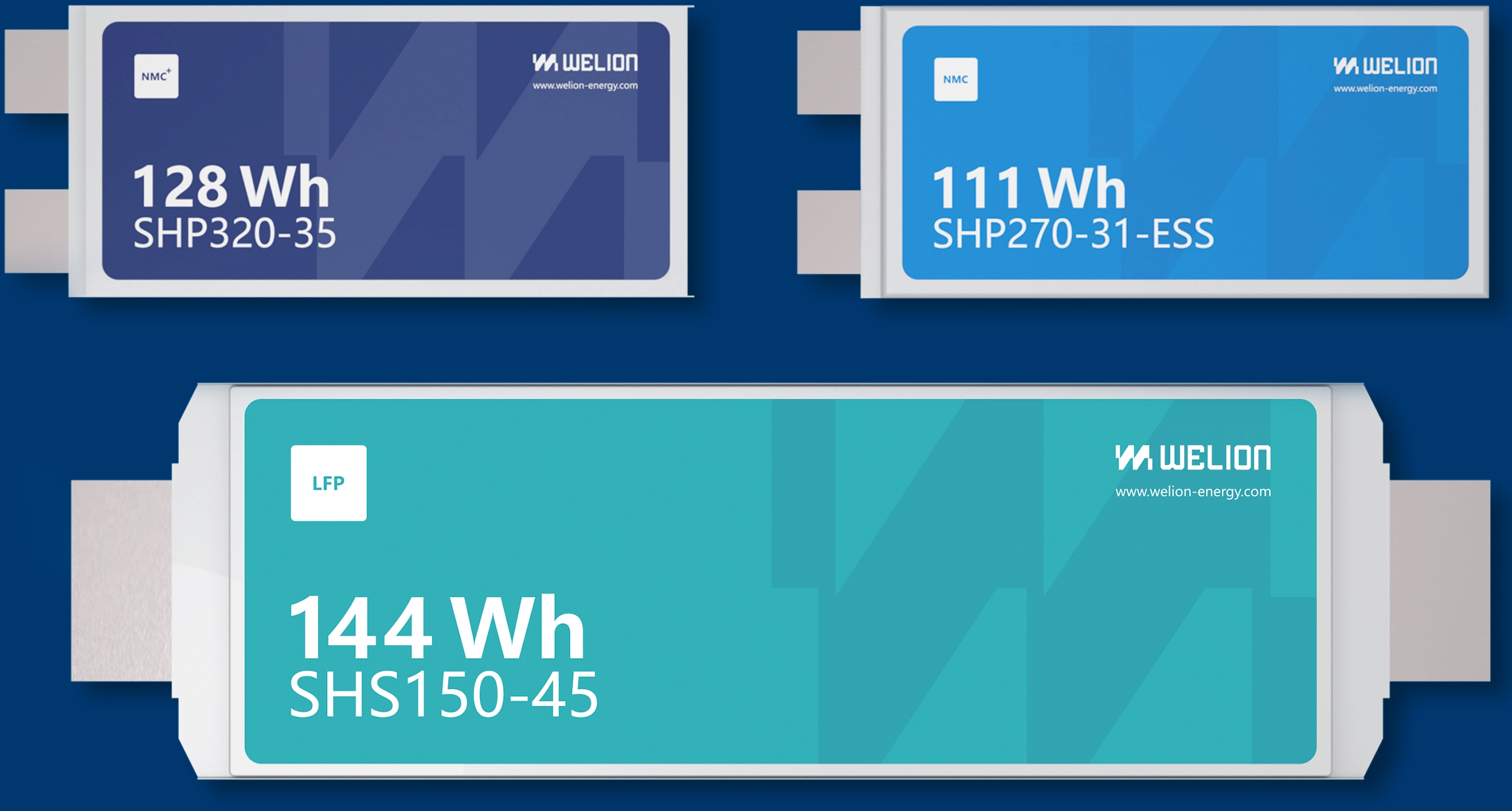
Solid state battery cell technology
The development of Welion's solid-state cell technology began at the Max Planck Institute for Solid State Research in Stuttgart, where founder Chen Liquan collaborated with Professor Dr. Werner Weppner in 1977, establishing the foundation for this innovation. Founded in 2016 and headquartered in Beijing, China, WELION is now a leading supplier of lithium-ion solid-state battery cells. With a production capacity exceeding 40 GWh across four facilities, we are committed to being your partner in delivering innovative and high-performance battery cell solutions. WELION is synonymous with enhanced

High energy density

Long life cycle

High safety
performance and operational reliability, even in extreme conditions. We have played a key role in shaping the concept of “intrinsic safety” within industry standards. Our products are ideal for light vehicles, aircraft, and stationary energy storage systems, offering exceptional energy density. Available in prismatic, pouch, and 4695 round cell formats, our cells provide energy capacities ranging from 50 Wh to 900 Wh per cell. With a focus on quality, safety, and performance, Welion continues to push the boundaries of battery technology to meet the evolving demands of tomorrow’s energy landscape.
Wide temperature adaptability

Cost-efficient

High C-rate performance
The development of Welion’s solid-state cell technology began at the Max Planck Institute for Solid State Research in Stuttgart, where founder Chen Liquan collaborated with Professor Dr. Werner Weppner in 1977, establishing the foundation for this innovation. Founded in 2016 and headquartered in Beijing, China, WELION is now a leading supplier of lithium-ion solid-state battery cells. With a production capacity exceeding 40 GWh across four facilities, we are committed to being your partner in delivering innovative and high-performance battery cell solutions. WELION is synonymous with enhanced performance and operational reliability, even in extreme conditions.
We have played a key role in shaping the concept of “intrinsic safety” within industry standards. Our products are ideal for light vehicles, aircraft, and stationary energy storage systems, offering exceptional energy density. Available in prismatic, pouch, and 4695 round cell formats, our cells provide energy capacities ranging from 50 Wh to 900 Wh per cell. With a focus on quality, safety, and performance, Welion continues to push the boundaries of battery technology to meet the evolving demands of tomorrow’s energy landscape.
High energy density
Long life cycle
High safety
Wide temerature adaptability
Cost-efficient
High C-rate performance
Nickel
Manganese
Cobalt Plus
NMC+ Products
The Powerful Sprinter
Industry leading energy density
Gravimetric densities of more
than
360 Wh/kg and volumetric densities up to 800 Wh/L allow for ultra-compact and lightweight battery
designs.
Extended Lifespan
Provides over 800 cycles at 97% DOD with more
than 80% remaining capacity. After 50,000 km on your bicycle or 100,000 km on your motorcycle, your
battery will still have 80% capacity remaining.
Maximum C-Rates
Welion cells deliver discharge rates up to 7C
with
pulses up to 10C, ensuring powerful performance for applications like motorcycles and eVTOLs.
Enhanced Safety
Performance doesn’t compromise safety NMC+
cells
are rigorously tested for overcharge, short circuit, overtemperature, and crushing.
Nickel
Manganese
Cobalt
NMC Products
The Versatile Allrounder
Superior Lifespan
Provides over 1000 Cycles 97% DOD with more
than
80% remaining capacity Energy storage for a lifetime.
High Energy Density
Gravimetric densities of more than 250Wh/Kg
and Volumetric densities up to 600Wh/l enable compact and lightweight battery designs.
Extra Safety
Robust designs pass industry-standard tests for
puncture, overcharging, short circuit, overtemperature, and crushing with flying colours.
Cost-efficient
Highly suitable for commercial and even offshore
applications where ESS (Energy Storage Systems) can be very efficient and achieve a short ROI.
Lithium
Iron
Phosphate
LFP Products
The Endurance Performer
Extraordinary Lifespan
Provides over 6,000 cycles at 97% DOD
with
more than 80% remaining capacity! This means charging every day for over 16 years and still having more
than 80% capacity left.
Extremely Fast Charging
Charge up for the next marathon ride in
just 1 hour while operating between –20°C and 60°C. Ideal for fleet and commercial applications.
Ultimate Safety
Passes gunshot, puncture, overcharge, short
circuit, overtemperature, flaming, and crushing tests. The safest way to store energy in batteries.
Extra Cost-efficient
An unmatched cost-efficient way to power
vehicles, homes, and factories—with the very high cycle life, extreme safety, and robustness of our LFP.
The historical development of battery cells can be divided into four important stages
1.
Lead-acid cell Invented in 1859, this was the first rechargeable battery. It uses lead plates and sulfuric acid, is heavy, and has a low energy density, but is still used today in cars and as a backup power source.
2.
Nickel-Metal Hydride (NiMH) This technology emerged in the 1980s and offered a higher energy density than lead-acid batteries. It is lighter, rechargeable, and was widely used in hybrid cars and portable devices.
3.
Lithium-ion
battery
Since the
1990s, lithium- ion batteries have dominated the market because they offer much higher energy
density, lower
weight, and longer lifespan. They are used in smartphones, laptops, and electric vehicles, but have
safety
issues (risk of ignition).
4.
Semi-solid-state battery This newer technology uses a hybrid solid/liquid electrolyte, which is safer and achieves higher energy densities without the high production costs of full solid-state batteries. It is considered a bridging technology towards solid- state batteries.
Each generation improved efficiency, energy density, and safety. The currently available WELION semi- solid-state battery cells have an energy density of up to 350 Wh/kg, making them among the most powerful battery cells on the planet.
Semi-solid-state battery This newer technology uses a hybrid solid/liquid electrolyte, which is safer and achieves higher energy densities without the high production costs of full solid-state batteries. It is considered a bridging technology towards solid- state batteries. Each generation improved efficiency, energy density, and safety. The currently available WELION semi- solid-state battery cells have an energy density of up to 350 Wh/kg, making them among the most powerful battery cells on the planet.
Professor Dr. Werner Weppner, Dr. Chen Liquan; Stuttgart 1977